
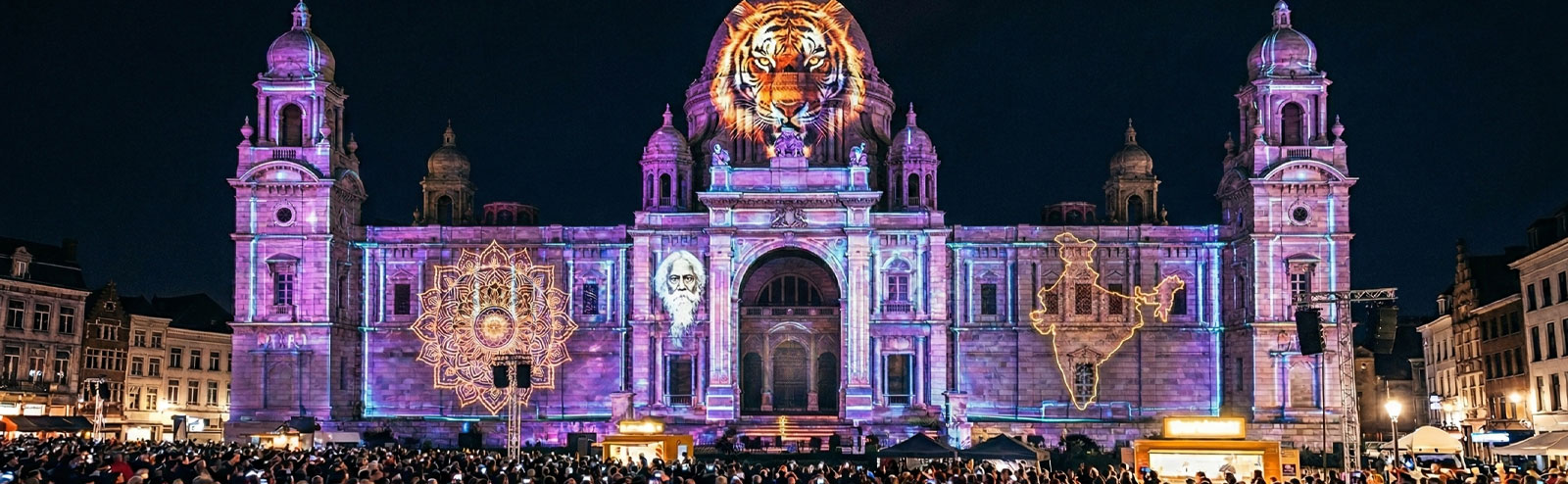
3D mapping often referred to as 3D projection mapping is an advanced visual technology that transforms physical surfaces into dynamic, immersive displays. By projecting precisely mapped visuals onto buildings, structures, or custom environments, it creates the illusion of movement, depth, and transformation in real time.
At its core, this technology blends art, engineering, and software to turn any surface into a storytelling medium. 3D Mapping India, a subsidiary of Showman Entertainment has already completed 3D mapping for 100+ brands across regions.
This is a multi-stage process that combines spatial accuracy with high-performance visual rendering:
1. Surface Mapping & 3D Modelling
The physical structure (building, stage, monument) is digitally recreated using 3D modelling tools. This ensures every edge, contour, and dimension is accurately captured.
2. Content Creation
Custom visuals are designed to align perfectly with the mapped surface. These may include animations, illusions, brand storytelling, or architectural transformations.
3. Projection Calibration
High-lumen projectors are strategically positioned and calibrated to match the geometry of the structure. This step ensures seamless alignment between the real-world surface and digital content.
4. Real-Time Playback & Synchronisation
Content is played through specialised media servers and can be synchronised with sound, lighting, and laser systems for a fully immersive experience.
This is powered by a combination of advanced tools and systems:
This integration allows for precision-driven visual storytelling at scale.
This is widely used across industries due to its versatility and visual impact:
1. Large-Scale Events & Concerts
Transforms stages and venues into immersive visual environments, enhancing audience engagement.
2. Tourism & Heritage Sites
Used to bring historical monuments to life through storytelling and light shows, boosting tourism appeal.
3. Government & Public Installations
Ideal for national celebrations, public awareness campaigns, and cultural showcases.
4. Corporate Events & Product Launches
Enables brands to create high-impact launches and experiential marketing campaigns.
5. Architectural Visualisation
Helps showcase building designs, renovations, or concepts in a visually engaging way.
6. Water Screen & Outdoor Shows
Combines projection with water screens and open environments for large-scale spectacles.
The industry is evolving rapidly, driven by innovation and integration:
AI-Driven Content
Artificial intelligence is enabling adaptive visuals that respond to audience behaviour and real-time inputs.
Real-Time Interactivity
Audiences can interact with projections via mobile devices, sensors, or motion tracking.
Integration with Laser Shows
Combining 3D mapping with laser technology is creating multi-layered immersive environments with higher visual intensity.
AR & VR Convergence
Hybrid experiences blending projection mapping with augmented and virtual reality are becoming more prevalent.
Sustainable Technologies
Energy-efficient projectors and eco-friendly setups are shaping the future of large-scale visual installations.
We specialises in delivering large-scale, technology-driven visual experiences that combine 3D mapping, laser systems, and immersive storytelling.
From heritage installations and government events to high-impact outdoor shows, the focus is on precision, innovation, and execution at scale.
This tech is no longer just a visual enhancement—it is a transformational technology redefining how audiences experience spaces, stories, and events. As advancements in AI, real-time rendering, and laser integration continue, 3D mapping will play a central role in the future of immersive environments.
For organisations looking to create powerful, large-scale visual impact, 3D mapping offers a compelling and future-ready solution.
To get a free quote, contact us.


