
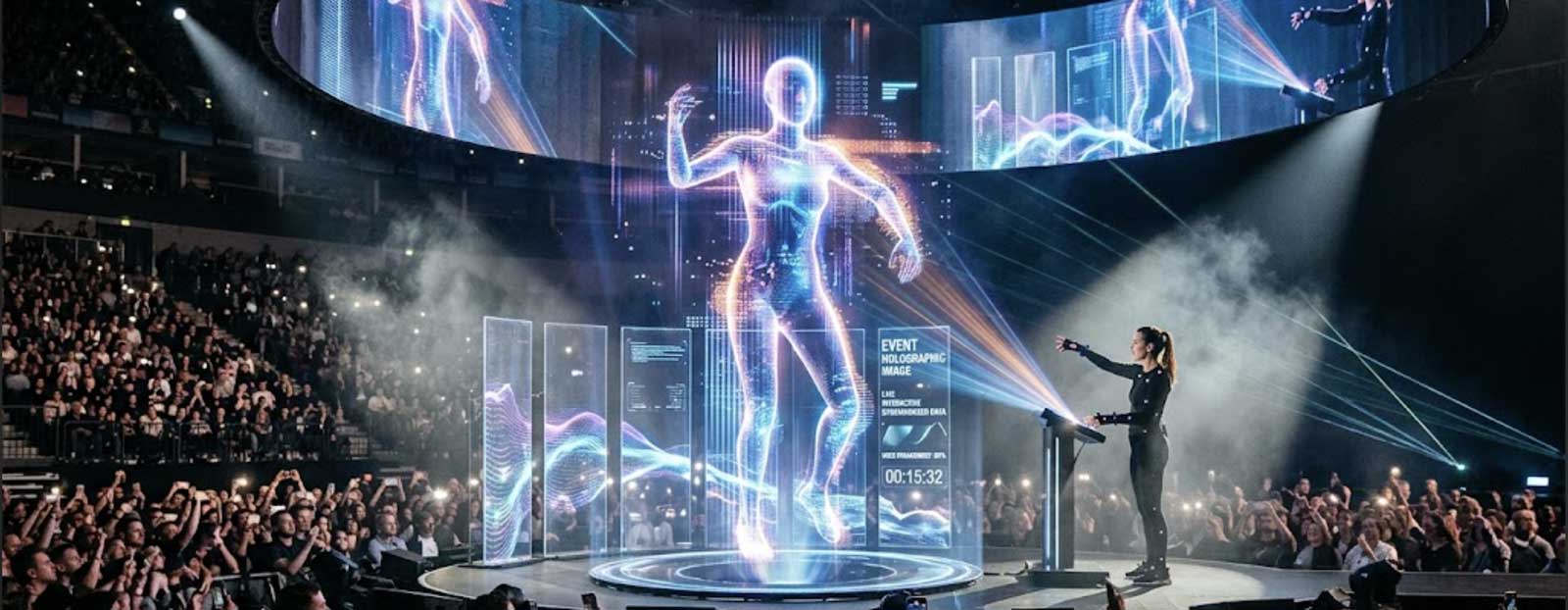
Holographic projection technology has become one of the most talked-about innovations in the event and entertainment industry. From product launches and corporate conferences to exhibitions and live performances, holographic displays are transforming the way audiences experience visual storytelling.
Despite its growing popularity, holographic projection is often surrounded by misconceptions. Many people assume it is futuristic science fiction, prohibitively expensive, or only suitable for massive events. These myths can prevent brands and event organisers from exploring a technology that can create truly memorable experiences.
In this blog, we separate fact from fiction and address the most common myths about holographic projection technology.
The Reality
Most commercial holographic event solutions do not create physically floating objects in mid-air. Instead, they use advanced projection techniques, transparent display films, reflective surfaces, specialised lighting, and visual illusion methods to create the appearance of three-dimensional objects suspended in space.
The effect is highly convincing and immersive, which is why audiences often perceive it as a true hologram. The goal is not physical levitation but creating a realistic 3D visual experience that captivates viewers.
The Reality
Holographic projection can be scaled for a wide variety of venues and audience sizes. It is used not only for large public spectacles but also for:
A well-designed small-scale holographic installation can be just as impactful as a large outdoor show. The key is aligning the solution with the event objective and audience experience.
The Reality
Costs vary significantly depending on the size of the installation, content complexity, equipment requirements, and production design. While premium large-scale holographic shows can involve substantial investment, many corporate and brand activations can be executed within practical marketing budgets.
Compared with building elaborate physical sets or experiential installations, holographic projection can sometimes offer greater flexibility and stronger audience recall for a comparable investment.
The Reality
Lighting plays a critical role in holographic projection quality. Bright ambient light, especially direct sunlight, can reduce visibility and weaken the illusion. This is why most outdoor holographic shows are scheduled after sunset and indoor installations often use controlled lighting environments.
Professional event designers carefully evaluate venue lighting and select appropriate projection systems to achieve optimal results.
The Reality
Standard video content rarely delivers the best holographic effect. High-impact holographic experiences typically require specially designed animations, 3D models, motion graphics, and perspective-aware content.
Custom content creation is one of the most important elements of a successful holographic project because it ensures the illusion appears natural, immersive, and visually compelling.
The Reality
When used strategically, holographic projection is far more than a novelty. It can serve clear business objectives such as:
Brands across automotive, technology, luxury retail, healthcare, education, and entertainment sectors use holographic projection to communicate innovation and create stronger emotional connections with audiences.
The Reality
One of the biggest advantages of holographic projection for live events is that audiences typically do not need any wearable devices. Unlike Virtual Reality (VR) or some Mixed Reality (MR) experiences, holographic displays are viewed directly, making them ideal for shared audience experiences.
This allows hundreds or even thousands of attendees to enjoy the same visual spectacle simultaneously.
The Reality
Although both technologies use projection, they serve different purposes.
In many advanced productions, both technologies are combined to create immersive multi-layered experiences, but they are not the same technology.
The Reality
Outdoor holographic projection is absolutely possible, but it requires specialised planning. High-brightness projection systems, controlled viewing angles, weather protection, and nighttime operation are often necessary to achieve convincing results.
Many successful public events, festivals, and brand activations have used outdoor holographic installations to attract large audiences and generate significant media attention.
The Reality
The demand for immersive experiences continues to grow across events, retail, entertainment, tourism, education, and corporate communication. Holographic projection is evolving rapidly alongside advances in projection systems, transparent displays, real-time rendering, and interactive technologies.
Rather than disappearing, holographic experiences are becoming more accessible, more interactive, and more integrated with other immersive technologies such as AR, MR, and projection mapping.
Holographic projection is not magic, science fiction, or an unattainable luxury. It is a sophisticated visual communication technology that, when designed and executed correctly, can transform ordinary events into extraordinary experiences.
The most successful holographic projects are those that combine creative storytelling, technical expertise, venue planning, and audience understanding. By moving beyond common myths, brands and event organisers can make informed decisions and unlock the full potential of immersive visual experiences.
At 3D Mapping India, we specialise in designing immersive holographic projection experiences for corporate events, product launches, exhibitions, cultural shows, and large-scale public celebrations. Our team combines creative content, advanced projection technology, and flawless technical execution to deliver visually stunning experiences that engage audiences and elevate brands.
Whether you are exploring holographic projection for the first time or planning a high-impact immersive event, we can help you choose the right solution for your objectives.
Ready to separate myth from reality and create a truly unforgettable event? Contact 3D Mapping India today.


