
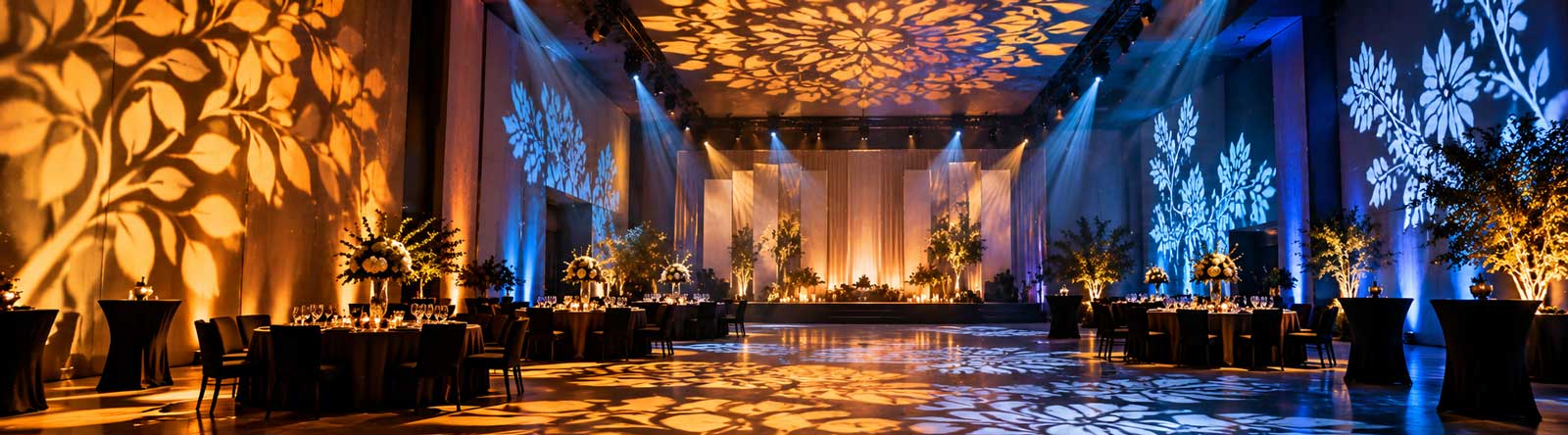
Event spaces often rely on lighting, décor and branding to create the right atmosphere. But instead of using lighting only for illumination, modern event planners are increasingly using it as a creative design element.
Gobo projection is one such technique that can transform walls, floors, ceilings and other surfaces with custom patterns, logos, monograms and visual designs. From corporate events and product launches to weddings and stage shows, gobo lighting offers a flexible way to add personality and visual detail to an event venue.
For event organisers looking for a creative alternative to traditional décor and signage, gobo projection for events can be an effective visual solution. Contact 3D Mapping India to know more.
Every event has its own visual identity. Gobo projection allows organisers to translate that identity directly onto the venue.
For example, a wedding can feature the couple’s initials or a customised monogram, while a corporate event can project the company’s logo or campaign graphics.
The result is a venue that feels more personalised without relying entirely on physical décor.
Brand visibility is an important part of corporate events, exhibitions, conferences and product launches.
Instead of displaying a logo only on banners and standees, custom gobo projection can place the brand identity directly onto walls, floors or stages.
A company logo projected behind a speaker or around a product display can reinforce branding while remaining visually integrated with the event design.
Stage lighting plays an important role in creating visual impact.
Gobo projection can introduce patterns, textures or branding elements onto stage backgrounds and surrounding surfaces. It can also be combined with moving lights, LED screens and other lighting technologies to create a layered stage design.
This is particularly useful when event organisers want to add visual detail without covering the entire stage with an LED wall.
Large blank walls can sometimes make an event venue feel plain. Gobo projection provides a way to turn these surfaces into part of the event experience.
Patterns, graphics, textures or logos can be projected onto suitable walls, architectural features or other surfaces.
This makes gobo lighting for events a practical option for venues where permanent décor or large physical installations are not suitable.
Weddings are one of the most popular applications for custom gobo projection.
Couples can project:
A monogram projected onto the dance floor or a decorative pattern covering the reception wall can become an elegant part of the wedding décor.
Large event venues often contain multiple areas, such as entrances, dining spaces, stages, photo zones and networking areas.
Gobo projection can help visually distinguish these spaces.
For example, a branded projection can be used near the entrance, decorative patterns can enhance the dining area, and event-specific graphics can define the stage or presentation zone.
This creates visual continuity while giving each area its own identity.
Gobo projection can be adapted to different event formats.
Businesses can use projected logos, campaign graphics and brand patterns at:
A product launch can use gobo projection to reinforce the new product’s branding and create visual anticipation around the launch area.
Custom monograms, names, dates and decorative designs can be projected onto dance floors, walls and stages.
Exhibitors can use projected logos and branded graphics to attract attention to their booth or presentation area.
Gobos can introduce textures, patterns and thematic visuals that complement stage performances and other entertainment elements.
For experiential marketing campaigns, custom projections can help create branded environments that encourage audiences to interact with and photograph the space.
Traditional event lighting can illuminate a venue, highlight performers and create atmosphere through colour and intensity.
Gobo projection adds another layer by introducing recognisable visual designs and patterns.
For example:
Traditional lighting:
A spotlight illuminates a stage.
Gobo projection:
A spotlight projects a company logo, pattern or custom graphic onto the stage surface.
This makes gobo lighting particularly useful when an event requires both illumination and visual branding.
Gobo projection and projection mapping are related but serve different purposes.
Gobo projection generally projects a defined pattern, logo or graphic onto a surface using a lighting fixture and gobo.
Projection mapping uses specialised projectors and software to map dynamic visual content onto complex architectural structures or objects.
Projection mapping can create highly detailed animations and transformations, while gobo projection is often used for focused branding, patterns and decorative lighting effects.
For event planners, the right choice depends on the scale, surface, content and desired visual experience.
Some key advantages of gobo projection include:
Before planning a gobo projection setup, several factors should be considered.
The colour, texture and reflectivity of the projection surface can affect how clearly the design appears.
The distance between the lighting fixture and the target surface influences the size and sharpness of the projection.
Strong surrounding light can affect the visibility of the projected design. The overall lighting plan should therefore be considered during event production.
Simple, high-contrast designs generally work well for gobo projection. Highly detailed artwork may require specific equipment or techniques.
The position of stages, walls, ceilings, furniture and other installations should be considered when deciding where the gobo will be placed.
The appropriate lighting fixture and lens should be selected based on the required projection size, distance and brightness.
Today’s events are increasingly designed as complete visual experiences rather than collections of individual décor elements.
Lighting, projection, stage design, digital displays and architectural surfaces can work together to create a cohesive environment.
Gobo projection fits into this approach by allowing event organisers to use light as a design tool. Instead of simply illuminating a venue, lighting can communicate a brand, highlight an architectural feature or add a personalised element to the event.
From a corporate logo projected onto a stage to a wedding monogram displayed across a dance floor, gobo projection for events offers numerous ways to customise a venue through light.
At 3D Mapping India, we create visual experiences using projection and lighting technologies tailored to the requirements of events, brands and venues. Gobo projection can be integrated with other event technologies such as projection mapping, laser shows, holographic projection and immersive visual experiences to create a cohesive event environment.
If you are planning an event and looking for custom gobo projection services in India, the right combination of design, equipment and placement can turn an ordinary venue into a more visually engaging space. Get a free quote.
Gobo projection is used to project customised logos, patterns, monograms, graphics and decorative designs onto surfaces at events. It is commonly used for branding, stage design, weddings and venue décor.
Yes. A company’s logo can be converted into a suitable gobo design and projected onto walls, floors, stages or other appropriate surfaces.
Yes. Gobo projection is commonly used for wedding monograms, names, dates and decorative patterns, particularly on dance floors, stages and reception walls.
Gobo projection typically uses a lighting fixture and stencil to project a defined design or pattern. Projection mapping uses specialised projection systems and software to display dynamic visual content across objects or architectural surfaces.
Yes. Corporate events can use gobo projection for logos, brand patterns, campaign visuals, stage backgrounds and other branded elements.
Yes. Gobo projection can be incorporated into larger event production setups alongside LED screens, stage lighting, projection mapping, laser shows and other visual technologies.


