
Technology is changing not only what we see, but also how we experience the world around us.
A building can become a moving canvas. A room can transport visitors into another world. A stage can react to performers in real time. A physical product can be surrounded by digital storytelling without changing the product itself.
This is the world of 3D immersive technology, where digital content, physical environments, light, sound and interaction come together to create experiences that feel larger, deeper and more engaging than conventional screens.
From 3D projection mapping and immersive rooms to holographic displays, interactive installations and extended reality, immersive technologies are increasingly being used across events, entertainment, museums, tourism, real estate, retail and corporate experiences.
There is no single technology behind an immersive experience. Depending on the application, multiple technologies can work together.
1. 3D Projection Mapping
3D projection mapping transforms physical surfaces into dynamic visual environments.
Buildings, monuments, stages, sculptures and unconventional structures can be mapped digitally so that visual content aligns precisely with their architecture and dimensions.
With the right creative treatment, walls can appear to collapse, structures can transform, architectural elements can move and entire façades can become part of a visual narrative.
This makes projection mapping particularly powerful for large-scale events, festivals, cultural shows, product launches, tourism experiences and public installations.
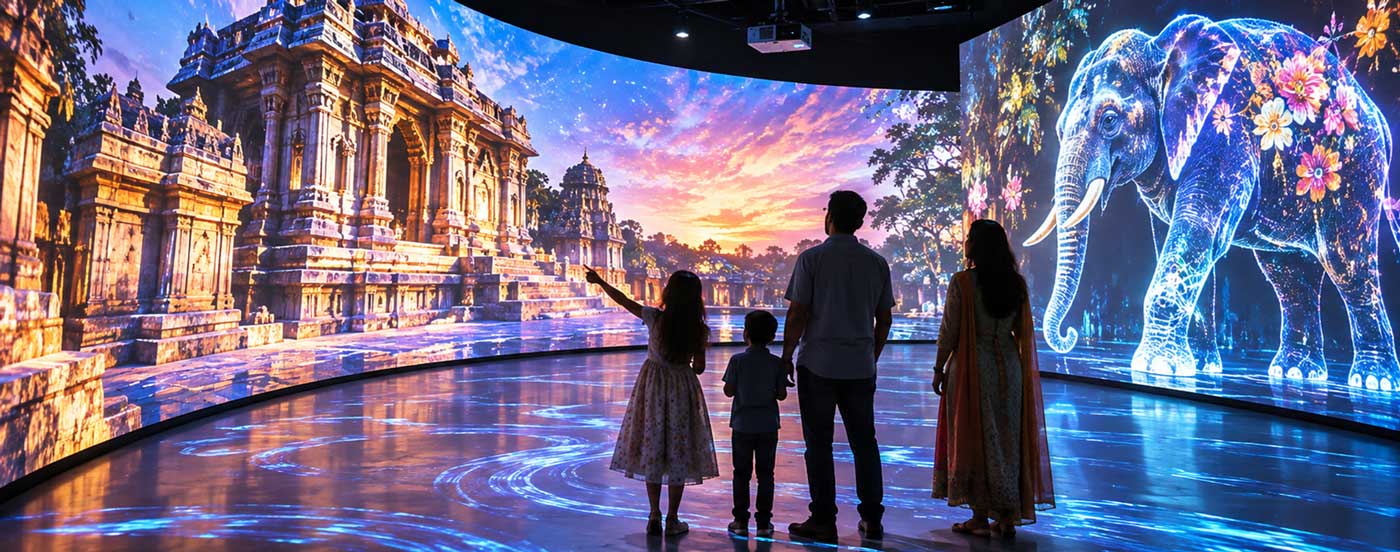
Imagine walking into a room where the walls and floor disappear visually and are replaced by an entirely different environment.
Multi-surface projection can create 360-degree or room-scale immersive environments, surrounding visitors with synchronised digital content.
A visitor could walk through a historical civilisation, explore a futuristic city, experience an underwater environment or step inside a brand story — all without physically changing the room.
These experiences have applications across museums, exhibitions, visitor centres, educational institutions, sales galleries and experiential marketing.
Holographic and hologram-style display technologies can create the illusion of three-dimensional objects or people appearing within a physical environment.
They can be used to showcase products, characters, historical personalities, digital presenters or visual concepts in ways that attract attention without relying solely on conventional displays.
For brands and exhibitions, this opens possibilities for futuristic product presentations and interactive storytelling.
Immersion can also happen at an individual level.
Virtual Reality (VR) places users inside completely digital environments, while Augmented Reality (AR) overlays digital information onto physical surroundings.
Mixed Reality (MR) goes further by allowing digital objects to appear anchored within and interact with the real environment.
Together, these technologies can enable virtual property tours, training simulations, interactive education, product demonstrations and entertainment experiences.
The next evolution of immersive technology is not simply visual — it is responsive.
Sensors, cameras, motion tracking and real-time rendering technologies can allow digital environments to react to audience movement and behaviour.
A person walking across a projected floor could cause digital ripples beneath their feet. A performer could trigger visual effects through movement. Visitors could influence the direction of a projected story.
This transforms audiences from spectators into participants.
Traditional media usually asks audiences to look at something.
Immersive technology invites them to enter, explore and interact with it.
That difference can fundamentally change how information, stories and brands are experienced.
Immersive environments can create greater visual impact, encourage audiences to spend more time with content and turn complex ideas into experiences that are easier to understand.
They are also naturally suited to today’s experience-driven environment, where audiences increasingly photograph, record and share memorable physical experiences online.
A well-designed immersive installation therefore has the potential to extend beyond the people physically present at the venue.
The possibilities extend across industries.
Events and entertainment can use projection mapping, interactive stages, laser experiences and immersive environments to create memorable live productions.
Museums and cultural spaces can recreate historical environments and communicate stories through visual narratives rather than relying entirely on static exhibits.
Tourism and public spaces can transform monuments, landmarks and destinations into night-time attractions through projection, light and sound.
Real estate can allow potential buyers to experience properties through interactive visualisation, immersive rooms and life-size spatial experiences before construction is complete.
Education can turn complex subjects into visual environments that students can explore.
Retail and brands can create interactive product launches, experiential stores and installations designed around participation rather than conventional advertising.
Corporate experiences can transform presentations, exhibitions and conferences into visually engaging storytelling platforms.
One of the biggest shifts created by immersive technology is the movement away from the traditional rectangular screen.
The space itself becomes the medium.
A building becomes a canvas.
A floor becomes an interface.
A room becomes another world.
A physical object becomes part of a digital story.
This gives designers and storytellers significantly more creative freedom because the experience is no longer restricted by the boundaries of a television, LED wall or mobile device.
The future of immersive technology is unlikely to be purely physical or purely virtual.
Instead, the two worlds are increasingly converging.
Projection mapping can interact with performers. Physical sets can blend with digital environments. Sensors can make projected content responsive. Artificial intelligence and real-time rendering can enable experiences to change according to audience behaviour.
As these technologies develop, immersive experiences can become increasingly adaptive, interactive and personalised.
At 3D Mapping India, we explore how technology can transform ordinary spaces into extraordinary visual experiences.
From 3D projection mapping and architectural projection to water screen projection, holographic experiences, laser shows, interactive installations and immersive visual environments, our focus is on bringing technology and storytelling together.
Every space presents a different creative opportunity.
A monument may become the canvas for a historical narrative. A corporate venue can transform into an immersive brand environment. A public space can become a large-scale visual attraction. An event stage can evolve into a dynamic world that changes throughout a performance.
The technology is only the starting point. The real impact comes from understanding the space, story and audience and designing the experience around all three.
For decades, digital experiences have largely existed behind screens.
3D immersive technology is changing that relationship.
Digital content is moving onto buildings, into rooms, across physical objects and throughout the spaces people occupy.
The result is a new form of storytelling where audiences do not simply watch something happen.
They step inside it.
And as projection, real-time rendering, spatial computing and interactive technologies continue to evolve, the boundary between the physical and digital worlds will only become harder to see.


