
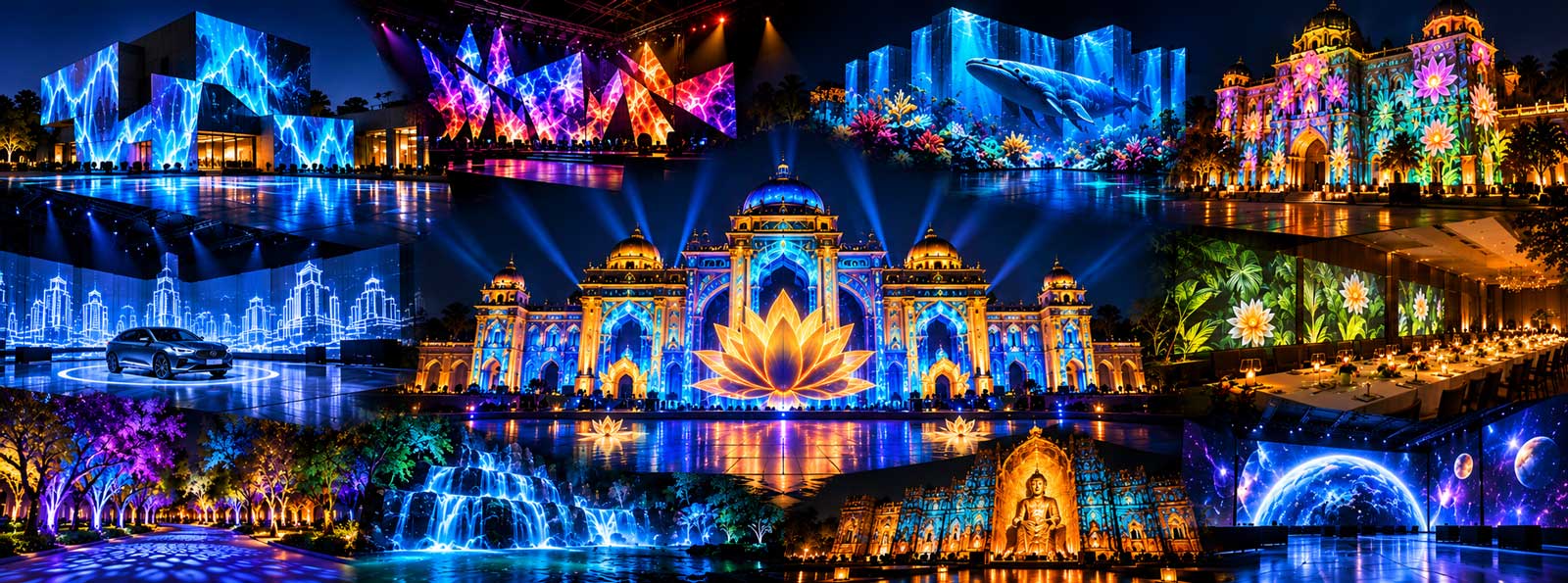
Events today are about more than bringing people together. They are about creating experiences that capture attention, communicate ideas and leave audiences with something memorable. While conventional stage backdrops, LED screens and lighting continue to play an important role, 3D projection mapping for events offers a different way to transform a venue into a visual experience.
By projecting carefully designed visuals onto buildings, stages, objects and architectural surfaces, projection mapping can make static structures appear to move, transform and tell stories. It allows event organisers to rethink how a space looks and how audiences experience it.
From corporate gatherings and product launches to cultural celebrations and large-scale public events, here are 10 creative ways to use 3D projection mapping at events.
A stage is often the visual centrepiece of an event. Instead of relying entirely on static backdrops or conventional LED screens, 3D projection mapping can transform stage structures into dynamic visual environments.
Visuals can be designed around the stage’s architecture, creating effects such as surfaces opening, structures appearing to dissolve or geometric elements shifting in sync with the event’s narrative.
This approach works particularly well for corporate conferences, award ceremonies, annual celebrations and large-scale entertainment events where the stage needs to reflect the occasion’s theme.
Product launches offer an opportunity to introduce a product through storytelling rather than a conventional presentation.
With 3D projection mapping, the product itself, its packaging or a specially designed installation can become the projection surface. Visual sequences can reveal individual features, demonstrate product capabilities or build anticipation before the official unveiling.
For example, a technology brand could use projection mapping to illustrate the evolution of a device, while an automotive brand could create a visual sequence highlighting a vehicle’s design and engineering.
When combined with lighting, sound and a carefully timed reveal, projection mapping can turn a product launch into a more engaging brand experience.
Architectural projection mapping uses the features of a building as part of the visual narrative. Windows, columns, arches and other structural elements become integral to the projected content.
At outdoor events, buildings can appear to change colour, reveal hidden architectural details or undergo dramatic visual transformations. The content can communicate a brand story, celebrate a milestone or present a cultural narrative.
This makes 3D projection mapping for outdoor events particularly suitable for festivals, public celebrations, destination promotions and landmark events.
The building itself becomes part of the experience, allowing organisers to create a large-scale visual spectacle without changing the underlying structure.
Corporate branding at events often involves banners, standees, printed backdrops and digital displays. Projection mapping offers another way to integrate brand identity into the venue.
Company logos, brand colours, campaign visuals and key messages can be projected onto stages, architectural surfaces and custom installations.
For an annual company celebration, for instance, a projection sequence could trace the organisation’s journey, highlight important milestones and introduce its future vision.
Rather than presenting branding as a separate visual element, projection mapping can make it part of the event environment. This is particularly valuable for brand activations, dealer meets, corporate anniversaries and leadership events.
Award ceremonies and gala evenings depend on atmosphere, anticipation and presentation. Projection mapping can support all three by creating visual transitions between award categories, introducing nominees and highlighting winners.
Stage surfaces can display animated patterns, thematic visuals and customised content that changes throughout the programme.
For example, each award category could have its own visual identity, while a central stage installation transitions between different themes as the ceremony progresses.
When synchronised with music, lighting and stage cues, these visual changes help maintain continuity throughout the event while making each segment feel distinctive.
Cultural events provide rich opportunities for projection mapping because architecture, history, music and storytelling can come together through visual content.
Historical buildings, monuments and purpose-built structures can serve as surfaces for narratives about local traditions, historical milestones, folklore and artistic heritage, subject to the necessary permissions and conservation requirements.
Visuals can illustrate historical scenes, recreate artistic patterns or bring cultural stories to life through animation and sound.
For festivals, tourism initiatives and heritage celebrations, projection mapping can offer audiences a different way to engage with stories that might otherwise be communicated through conventional performances or static displays.
Careful planning is essential when projecting onto heritage structures to protect the site and respect its architectural significance.
Projection mapping can also contribute to interactive event experiences when integrated with suitable sensors, tracking systems or interactive software.
For example, an activation zone could respond to visitors’ movements, allowing projected graphics to change as people approach or interact with an installation. A branded environment might react to gestures, while a projected floor could respond to movement with animated visual effects.
These experiences encourage active participation rather than passive viewing.
Interactive projection mapping can be particularly useful at exhibitions, trade shows, experiential marketing campaigns and consumer-facing brand activations, where the objective is to encourage visitors to spend time with the brand.
The level of interaction depends on the technology used, the environment and the experience being designed.
Projection mapping is not limited to walls and buildings. Three-dimensional objects can also become projection surfaces.
Vehicles, sculptures, product replicas and custom-built installations can be mapped with visuals designed to follow their contours and dimensions. This creates the illusion that an object is changing materials, revealing internal components or transforming into something entirely different.
At an automotive launch, for example, projection mapping can highlight a vehicle’s exterior design through animated sequences. At a technology exhibition, a custom installation could display the evolution of a product or demonstrate its features visually.
Successful object mapping requires accurate measurements, careful content alignment and suitable projection conditions.
Projection mapping can become more impactful when integrated with other event technologies.
Music establishes rhythm and emotion, lighting shapes the atmosphere, and laser shows introduce precise beams and patterns. Projection mapping adds depth by transforming physical surfaces into animated visual elements.
When these elements are synchronised, they can create a unified performance rather than a collection of separate effects.
For example, a large-scale event could feature a building facade that transforms in time with music, with laser beams accentuating key moments and lighting changes reinforcing the visual narrative.
This approach is suitable for opening ceremonies, entertainment shows, festivals, brand celebrations and large-scale public events.
The key is to coordinate every technology around a clear creative concept rather than using effects simply for visual intensity.
The opening moments of an event set expectations for everything that follows. Projection mapping can establish the theme and build anticipation before a speaker, performer, brand or product is revealed.
A stage structure might appear to break apart, an architectural surface might seem to open into a new visual world, or a series of animations could lead towards a central reveal.
These effects are created through carefully designed content, precise alignment and timed coordination with sound and lighting.
For corporate events, product launches and large-scale celebrations, projection mapping can provide a distinctive opening sequence that introduces the event’s central message.
The appeal of 3D projection mapping lies in its ability to turn physical spaces and objects into active elements of an event.
Instead of treating a stage, wall or installation as a static background, projection mapping allows it to become part of the storytelling. This creates opportunities for more distinctive presentations, immersive environments and visually cohesive brand experiences.
It is particularly useful when the event requires a strong visual identity, a dramatic reveal or a creative way to communicate a message to a large audience.
However, projection mapping is not automatically the best solution for every event. The venue, budget, audience, creative brief and production requirements should determine whether it is more suitable than an LED wall, conventional lighting or another visual technology.
At 3D Mapping India, projection and visual technologies can be used to develop distinctive experiences for corporate events, product launches, brand activations, cultural celebrations and large-scale productions.
From architectural projection mapping and stage transformations to integrated visual shows featuring laser lighting and other immersive technologies, the right solution begins with understanding the venue, the audience and the story the event needs to communicate.
Whether the objective is to introduce a product, transform a building facade or create a memorable opening ceremony, a well-planned projection mapping experience can help turn an ordinary event space into a compelling visual environment.
Planning an event that needs a distinctive visual experience? Explore 3D Mapping India’s projection mapping solutions to find an approach suited to your venue, creative vision and event objectives.
3D projection mapping is used to transform stages, buildings, products, sculptures and other surfaces with customised visual content. Common applications include product launches, corporate events, award ceremonies, festivals, brand activations and cultural events.
Yes. Outdoor projection mapping can be used on building facades and other suitable large surfaces. The setup must account for projector brightness, ambient light, projection distance, weather protection and site conditions.
An LED wall displays content on a dedicated electronic screen. Projection mapping uses projectors to display visuals on existing structures or objects, integrating the content with their shapes and architectural features. The appropriate option depends on the venue, content, viewing conditions and production goals.
Yes. Projection mapping can be synchronised with music, laser shows, stage lighting and other effects to create a coordinated visual performance. This requires suitable content design, control systems and production planning.
The cost depends on the projection surface, venue size, number and brightness of projectors, content complexity, equipment requirements, event duration and technical setup. A customised quote is generally needed to determine the cost of a specific project.
It is best to consider projection mapping during the initial event-planning stage, particularly for large-scale architectural installations or complex stage designs. Early planning allows sufficient time for site assessment, content creation, equipment selection, technical coordination and rehearsals.


