
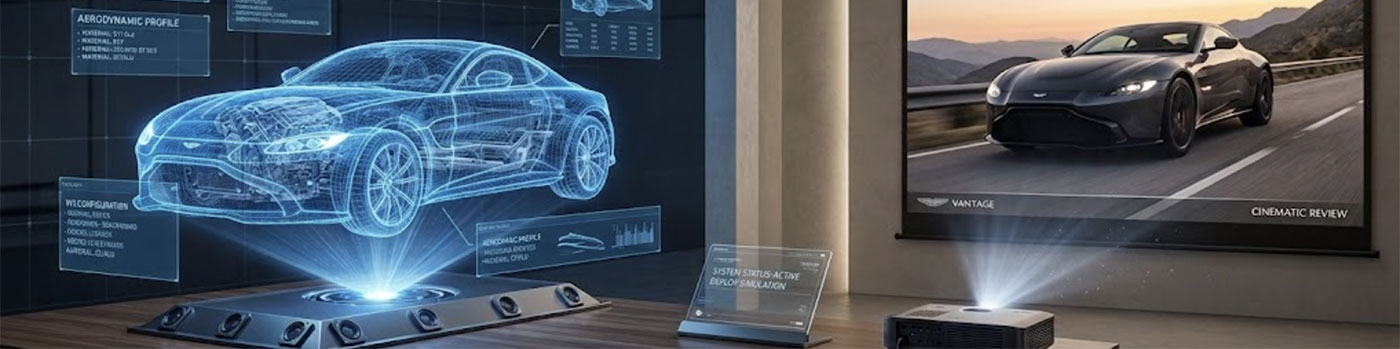
Visual technology has become the centrepiece of modern events. From product launches and corporate conferences to exhibitions and entertainment shows, organisers are constantly looking for innovative ways to captivate audiences. Two of the most popular display technologies are holographic projection and traditional projection.
While both are designed to showcase visual content, they create entirely different experiences. Understanding their differences can help you choose the right technology for your next event.
In this guide, we’ll compare holographic projection and traditional projection, exploring how each works, their applications, advantages, and the best scenarios for using them.
Traditional projection is the process of displaying images, videos, or presentations onto a flat surface such as a screen, wall, or stage backdrop using a projector.
It has been a reliable solution for decades across business presentations, conferences, classrooms, cinemas, and live events.
Common Applications
Traditional projection is valued for its simplicity, cost-effectiveness, and ability to display high-quality content over large surfaces.
Holographic projection creates the illusion of three-dimensional objects or people appearing to float in space. Unlike traditional projection, it doesn’t rely solely on a flat screen to deliver the experience.
Using specialised display systems, reflective films, transparent screens, lighting techniques, or advanced holographic technologies, this projection produces visuals with depth, making digital content appear more lifelike and immersive.
Although many event solutions marketed as “holograms” use visual illusion techniques rather than true holography, they create highly realistic 3D effects that captivate audiences.
Common Applications
This projection is designed to create memorable experiences rather than simply display information.
1. Audience Experience
Traditional Projection
Traditional projection delivers content clearly and effectively but presents visuals on a flat surface. The focus is on communication rather than immersion.
Holographic Projection
This projection creates the illusion of depth, making products, presenters, or animations appear to exist within the event space. This creates a stronger emotional connection and a greater sense of wonder.
Winner: Holographic Projection
2. Visual Impact
Traditional projection is ideal for presentations and video playback, while holographic projection transforms content into an engaging visual spectacle.
For product reveals, holographic effects can make an object appear to materialise from thin air—something impossible with conventional projection.
Winner: Holographic Projection
3. Content Requirements
Traditional projection supports virtually any standard presentation or video content.
Holographic projection often requires specially designed animations and 3D content to maximise its visual potential. Careful planning ensures the illusion appears realistic and seamless.
Winner: Traditional Projection (for simplicity)
4. Event Objectives
Choose traditional projection if your goal is:
Choose holographic projection if your goal is:
5. Installation Complexity
Traditional projection systems are generally straightforward to install and operate.
Holographic projection requires specialised equipment, careful alignment, controlled lighting conditions, and experienced technical teams to achieve the desired illusion.
Winner: Traditional Projection
6. Audience Engagement
Audiences increasingly expect experiences rather than presentations.
Holographic projection naturally attracts attention because it introduces surprise, movement, and perceived three-dimensional depth. These immersive visuals often encourage guests to capture and share content on social media, extending the reach of your event.
Winner: Holographic Projection
Traditional projection remains an excellent choice for many events.
It’s ideal when:
For conferences, training sessions, and internal meetings, traditional projection offers dependable performance.
Holographic projection is best suited for events where creating a lasting impression is the priority.
Choose holographic projection for:
If your goal is to make audiences stop, watch, and remember, holographic projection delivers an extraordinary visual experience.
Absolutely.
Many successful events combine traditional projection and holographic projection to achieve the best of both worlds.
For example:
This hybrid approach balances functionality with high-impact visual storytelling.
The choice depends on your event objectives.
|
Traditional Projection |
Holographic Projection |
| Presentations |
Product launches |
|
Conferences |
Brand activations |
|
Training sessions |
Experiential marketing |
|
Educational events |
Luxury events |
|
Informational content |
Immersive entertainment |
| Budget-conscious projects |
Premium visual experiences |
If your priority is delivering information clearly, traditional projection remains a dependable solution.
If your objective is creating an immersive, memorable experience that leaves audiences talking long after the event, holographic projection offers a level of engagement that traditional projection cannot match.
At 3D Mapping India, we deliver cutting-edge visual experiences using holographic projection, projection mapping, immersive displays, and advanced event technologies. Whether you’re launching a new product, hosting a corporate event, or creating a large-scale public spectacle, our team designs customised solutions that combine creativity with technical excellence.
From concept development to flawless execution, we help transform your vision into an unforgettable audience experience.
Ready to elevate your next event? Contact 3D Mapping India to discover the right projection solution for your brand.


